
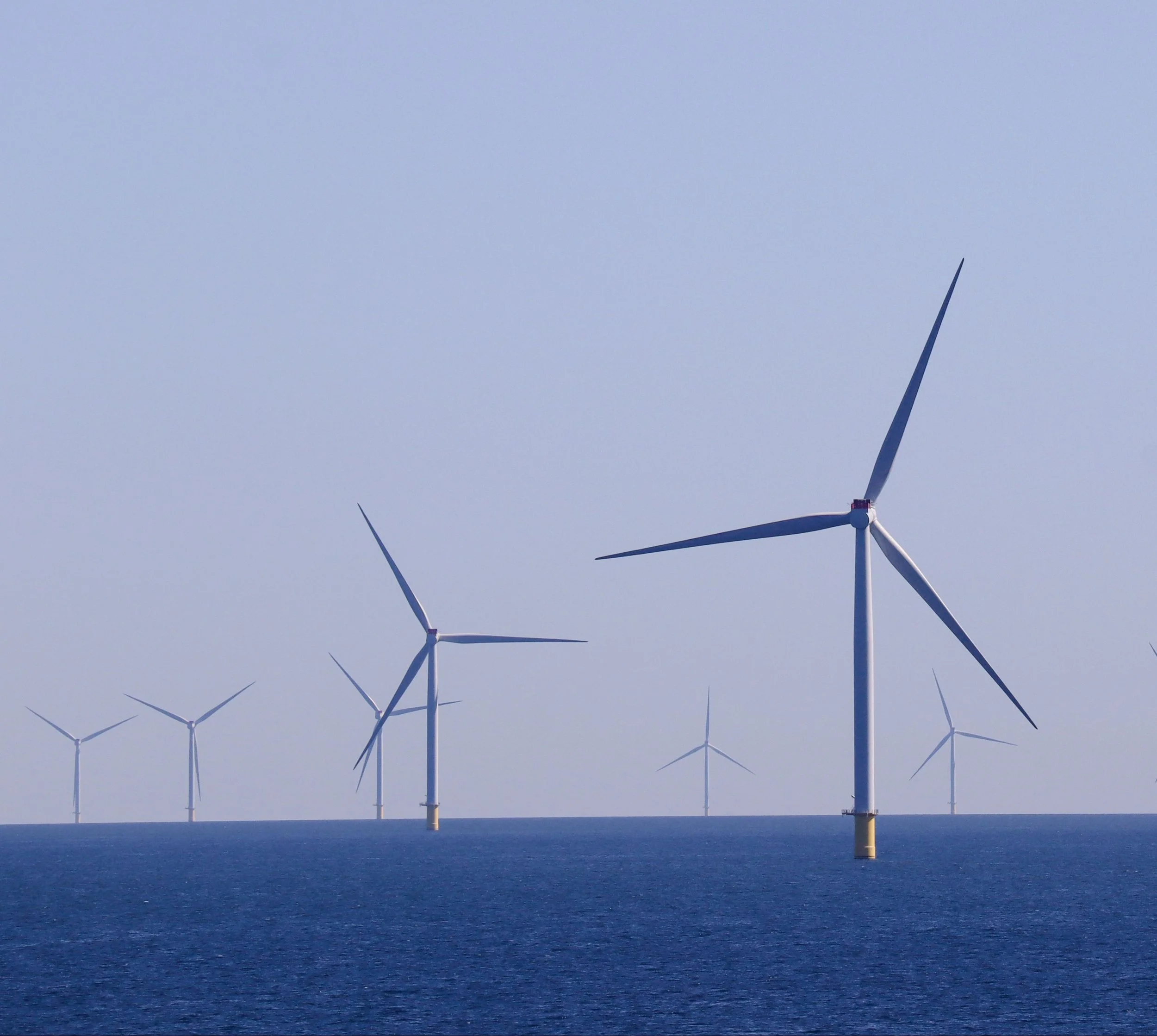
Why is the North Sea energy system stuck?
Written by Charmaine Che and edited by Brian Blankinship
A systemic view of Europe’s energy build-out in the North Sea basin, why it is suffering from a maturity trap, and the leverage points that can shift this.
The North Sea is one of the most crowded maritime spaces in the world, and growing more so. Offshore wind and grid interconnection targets are rising, carbon storage is moving from concept to commitment, and the basin's coastal nations share a serious appetite for decarbonisation. And yet, by almost any measure that matters, including cost, speed and coordination, the system is not delivering what its stated energy ambitions would predict.
To understand why, we supported a client recently in building a systems map of the North Sea energy system – a causal model of how the basin's many moving parts interact, drawn from interviews with operators, regulators, developers and transmission bodies.
Now, why a systems map, you may ask? It is a particularly useful tool for getting behind the symptoms of the problem and surface the underlying structure that produces the patterns and stubborn challenges we observe; it is also where we might be able to see the problem as a whole before we can be truly targeted at where a small, well-placed intervention might shift the whole.
What we learned was that North Sea energy is not held back by a shortage of ambition, money or technical acumen, but by the very ambition that drove its early successes: by focusing on symptoms over structural redesign, the perceived ‘quick fixes’ often deepen the very problems they intend to solve. Below are five insights that, taken together, explain the basin's coordination trap and point toward where real leverage lies.
Insight 1: The system isn't stuck for lack of ambition; it's stuck by design.
The most important fact about the North Sea energy system is also the easiest to overlook: it was historically built as a collection of projects rather than an integrated system. Each wind farm and other national programmes were optimised on their own terms, often as radial connections, producing fast early progress and getting near-shore turbines built and connected to the grid. But a decade in, the low-hanging fruit is all but exhausted, the waters are crowded, and community patience is wearing thin.
Localised, project-by-project optimisation steadily pushes the basin toward its growth ceiling, a limits-to-growth dilemma in which carrying capacity now outcompetes the industry's own learning curve. Layer onto it an onshore grid that is outdated and backlogged (40% of the European grid is over 40 years old), and the result is an uncoordinated scramble for shared space and resources, increasing congestion, delays and cost overruns. Each of those reinforces the legacy model's inertia, locking actors into a zero-sum competition that becomes ever harder to break out of.
The highest leverage will not come from more deployment, which only piles pressure onto the very bottlenecks the legacy model created. Leverage comes instead from shifting what gets rewarded, towards shared infrastructure and interconnection. The deeper move is to change the rules of the game, so that success is measured not by the gigawatts installed but by building towards system integration, shared resilience and nature impact per unit of energy delivered.
Insight 2: What really drives coordination? Securitisation, not Net Zero.
So better and more integrated coordination is key. But what drives it?
It is tempting to assume that a shared ambition to safeguard the climate is what drives North Sea nations to cooperate. Our findings suggest the strongest force shaping whether nations coordinate or retreat is how each perceives its own energy security, which in a region that has learned hard lessons about geopolitical instability is increasingly tied to national security.
Through that lens, the shift to renewables is double-edged: it can limit exposure to imported feedstocks, yet it also puts wind turbines and subsea interconnectors at risk of sabotage. Securitisation can be the system's most powerful coordination engine or its most effective fragmentation trigger, depending on how it is framed. If it is framed as a way to fortify national sovereignty, it justifies siloed action: building one's own assets, guarding one's own data, hesitating to build co-owned or shared infrastructure; if it is framed as shared resilience, the same impulse justifies pooled funding, interoperable infrastructure and common standards. The irony is that it comes from a shared instinct, but the consequences are opposite.
The map shows why the inward-looking stance creates a ‘spiral of insecurity’. The perception that there are winners and losers to the energy system, that benefits and costs are being shared unequally, is made tense by the political visibility and salience of energy prices. When energy prices are high (as they have been known to be highly fluctuating), that exacerbates the perceived unfairness, deepens the inertia to act and leads governments to pause or defer efforts to pursue wider system integration work (as it is inherently complex and slow). However, this creates in itself a missed opportunity to capture the price efficiency integration could deliver. On the flip side, when securitisation leads governments to push toward cooperation in principle, there is also an inherent pattern to overcome, which we’ve identified as a ‘fixes that fail’ archetype: while national energy security in principle might be what brings around the meeting table, in practice it could also limit the data sharing that joint marine spatial planning depends on.
To break this cycle, nations must come together around an energy security-as-resilience agenda. The leverage here is doctrinal rather than technical. If security can be authoritatively redefined as interoperability, redundancy, shared infrastructure and reliability, it flips from being a fragmentation trigger to a cooperation engine for North Sea energy.
Insight 3: Bilateral collaboration feels like a quick fix, but it shifts the burden away from true system integration.
Nations must build the muscle of collaboration, and when faced with the basin's coordination problem, many countries defer to bilateral deals as a pragmatic shortcut, a way to ease friction and demonstrate progress without the slow, politically demanding work of multilateral alignment.
The big lesson from our work revealed that while bilateralism can accelerate delivery, it is multilateralism that determines direction. The system is fundamentally multilateral: its infrastructure, markets, security and governance all operate across many states at once. Bilateral leverage is therefore conditional – gains secured in one partnership can be diluted or reversed by actions elsewhere.
This can be explained by a systems archetype called ‘Shifting the Burden’. A fundamental solution exists, i.e. deep multilateral cooperation, but it is slow, complex and politically costly. A symptomatic solution, i.e. bilateralism, offers faster, more visible relief. Each time the system reaches for the quick fix, it relieves short-term pressure but adds congestion and incompatibility with shared frameworks. Over time, this erodes the institutional capacity and appetite to pursue the fundamental solution – dependence on the shortcut deepens, and comprehensive integration becomes harder and harder.
The point is not that bilateral deals are bad, it is that they need to be nested inside a multilateral direction. The strongest position in the basin is a dual strategy: using bilateral projects as proof points within broader coordination frameworks, while investing simultaneously in system-wide rule-shaping, standards and interoperability. The most embedded actors treat multilateralism as “the air they breathe” – the shared rules and architecture that let bilateral projects actually be operationalised toward joint resilience. Those that lean only on bilateralism risk locking into suboptimal architectures and finding their assets becoming liabilities in a system whose rules are being written elsewhere.
True leverage and enduring influence flows less from optimising individual partnerships than from shaping the rules through which the whole system connects.

Insight 4: The project economics of energy build-out are structurally fragile.
Underlying the politics of the system, there is of course the technoeconomic layer. Energy development in the North Sea runs on a global, borderless capital market, and investment moves quickly to whichever jurisdiction looks more stable. That mobility makes the basin's project economics fragile: small increases in uncertainty, whether from geopolitical instability, price volatility, policy change or inconsistent auctions, can trigger disproportionate ripple effects, up to a collapse in investment confidence.
This functions as a vicious cycle. Fragility reduces bidder participation, weakens project pipelines and discourages supply-chain investment, which drives costs higher and further undermines the viability of the next round of projects. The August 2025 German offshore wind auction that failed on negative bidding is the kind of signal this feedback loop produces and amplifies.
Crucially, this fragility is not only financial, it is also socio-political. The transition is acutely vulnerable to public and political backlash, particularly where rising costs or perceived unfairness in how benefits are distributed erode trust. These dynamics are not linear – a single contested project can cascade into wider policy and capital risk.
Here we actually found that a very intervenable lever is in shifting the perceived fairness and accountability to affected communities rather than more public consultation. Social licence should be treated as designed infrastructure rather than a reactive afterthought. Bringing fairness, transparent community benefit and credible social dialogue upstream, for example into access and leasing conditions rather than bolting them on after opposition emerges, will significantly help in creating legitimacy and overcoming barriers to speed and cost of delivery.
Insight 5: The grid is where lock-in becomes physical.
Finally, the North Sea system can only move at the speed of how quickly the physical infrastructure can be updated and come online. The basin's grid is the clearest case of path dependence: every point-to-point connection raises the future cost of meshing, so developers rationally minimise their own risk rather than preserve system optionality, pushing a meshed offshore grid further out of reach with each project.
What makes this so hard to escape is that almost every feedback loop in the transmission system is a balancing loop, so the system repeatedly dampens its own attempts at structural change. Pressure to coordinate strengthens centralised planning, which creates short-term rigidity and reinforces established models; grid backlogs erode investor confidence; frontier ambitions deflate as their costs become clearer. Each loop returns the system to the radial status quo.
The two interconnectors examined in our work, UK-Germany's NeuConnect and UK-Denmark's Viking Link, show both faces of the trap. One, built outside coordinated planning, improves short-term efficiency but locks in suboptimal infrastructure. The other proves cooperation genuinely works, but only because it was single-purpose and tightly bound, a stepping stone rather than a blueprint.
The most coordinated systems avoid this by embedding meshed infrastructure early, treating multipurpose interconnectors as public infrastructure rather than developer risk. The lever is to reward system optionality (not just connection), and create regional accountability and cost-benefit sharing mechanisms for mesh-ready infrastructure before the radial path closes off the alternatives.
Where leverage actually lies
Read together, these five insights describe some recognisable patterns of stagnation: rational local action, a legacy structure that punishes coordination, seductive shortcuts, fragile confidence, and physical lock-in. The encouraging implication is that the leverage points are correspondingly clear, and three kinds of intervention stand out.
Platforms – fix the information flow. Build shared, authoritative data architecture and governance for the basin (seabed constraints, cumulative environmental pressure, grid queues, corridor plans, sequencing). Transparency reduces the defensive behaviour that tends to worsen congestion.
Rules – change what gets rewarded. Make access and awards contingent on interoperability and shared-infrastructure readiness, and bring fairness and accountability into leasing conditions upstream. Shift the default from project optimisation to system integration.
Signals and doctrines – redefine the paradigm. Reframe security as resilience rather than self-reliance, and position the basin's leading actors around a coordinated, multi-vector portfolio. Doctrine changes behaviour where incentives alone cannot reach.
None of these on their own are new, seismic or revelatory ideas, but that is precisely the point. North Sea energy will not disentangle itself through mere force or acceleration. It needs a few precise changes to intervene in shifting the structural dynamics that have shaped the patterns and behaviours in this system that have made it stuck.
The Overton window is shifting and the moment to push for change is now. At the 3rd North Sea Summit in Hamburg that took place in January 2026, new interconnection targets were launched, and the North Sea has a renewed mandate to take meaningful action towards greater energy system integration. With the dedicated discipline to intervene where it counts, and precise action on coordination and collaboration, the North Sea basin could reverse its trajectory and build a low-cost, resilient, nature positive and decarbonised energy system.
If you wish to discuss any aspects of this article or explore how we could collaborate on similar projects, please reach out to Charmaine, who led this project, or Brian, who developed the systems map for this project.
This article summarises findings from a systems-mapping study of the Northwestern European continental shelf maritime and coastal energy system. The underlying model contains the full set of feedback loops, country analyses and intervention detail behind each insight, and can be found here. (password: TCEenergy)
