

The UK Science and Innovation Ecosystem
Written by Kate Wolfenden
For the last 9 months we have been conducting a whole systems analysis on the health and resilience of the UK’s science technology and innovation ecosystem. The work was contributed to by 30+ experienced practitioners across the spectrum of the innovation ecosystem and has resulted in a community owned systems map, and a suite of interventions and strategies for adoption by the industry.
The findings that we share below have led us to believe that our current and indeed rational response mechanisms to national innovation and growth strategies are creating significant system fragility. At a time when the coming transformation of AI & Automation is concentrating wealth and value creation into ever fewer hands, we are narrowing our critical geographic, sector and talent diversity at a time we may need it most.
Our task now is to translate this systems wide insight into applied and practical strategies for key stakeholders within the system. In the meantime, we wanted to share our key findings with you today. If you would like to read more, please visit our systems map, here, or if you would like to receive the full findings report, please reach out to me directly.
Insight #1: Resilient, long-term national innovation strategy is no longer an economic preference. Now, more than ever, it is a national security concern.
South Korea invests 5.3% of GDP in R&D, while the UK sits at just under half of that at 2.6%. More worryingly, we’ve cycled through five named innovation strategies in the same time that our peers - from China to Germany - have cycled through 2. The result? Our investments are below the OECD average and roughly level with China: a middle-income economy. The gap isn't just about spending, though, its about long term leadership. Looking at our peers, it is clear they recognise the significance of leading the next generation of technological transformation and are focused on the long term. The US has just committed $52.7bn to domestic manufacturing and R&D through the CHIPS and Science Act, while South Korea has maintained presidential-level R&D coordination since 1989; and Germany has hosted the Fraunhofer Society, amassing and aligning 76 institutes since World War II. Ever more so, as tariffs are banded around and technological advances are blocked across boundaries, our peer countries have stopped treating this as just an innovation question and started treating it as one of security.
The UK Science & Innovation Ecosystem: Our 5 key insights and recommendations
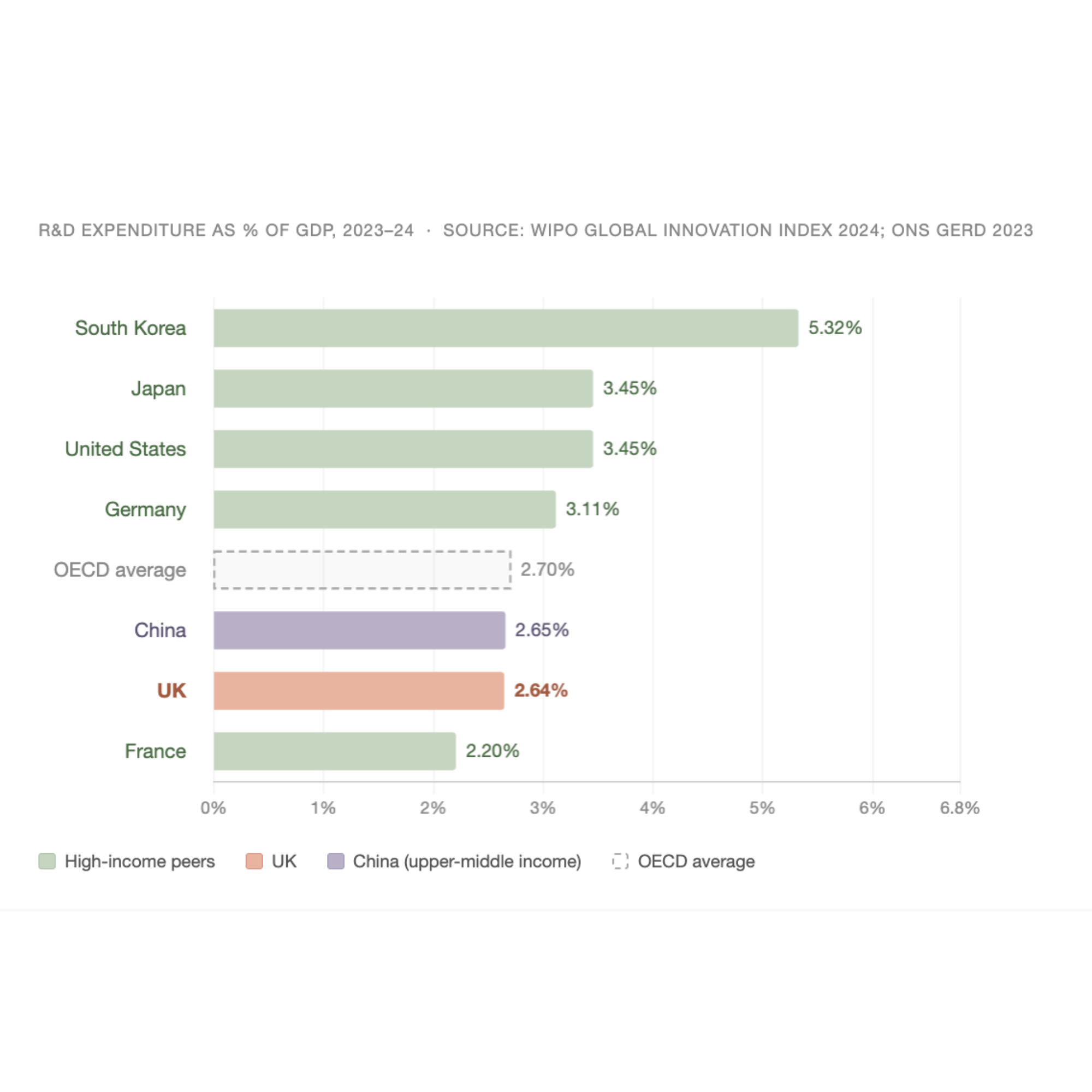
% of R&D intensity against GDP
# of named innovation strategies since 2000
Insight #2: The UK's innovation base is shrinking. Current policy is rightly backing frontier sectors, but the concentration is narrowing further, and challenging an already pertinent inclusion need.
AI, quantum and biotech are genuine national strengths, and the IS8 strategy reflects that. But our sector concentration is narrowing further into capital-intensive industries with historically narrow participation structures: the founders, funders and returns are pooling into an ever small number of hands and places — and the data shows this is accelerating, not stabilising. As an example, almost half of all UK venture investment in 2024 went to AI-powered companies, from a seed-funding pool that is already down 40% since 2023. This means that everything else, from clean tech to creative industries, and from manufacturing innovation to agri-tech, are left fighting over the remaining half. And the capital that is flowing isn't flowing evenly: 68% of all UK AI funding is raised in London alone, and only 3.5% across Britain is allocated to all female founding teams, despite diverse teams proving to be equally as economically successful as all male teams.
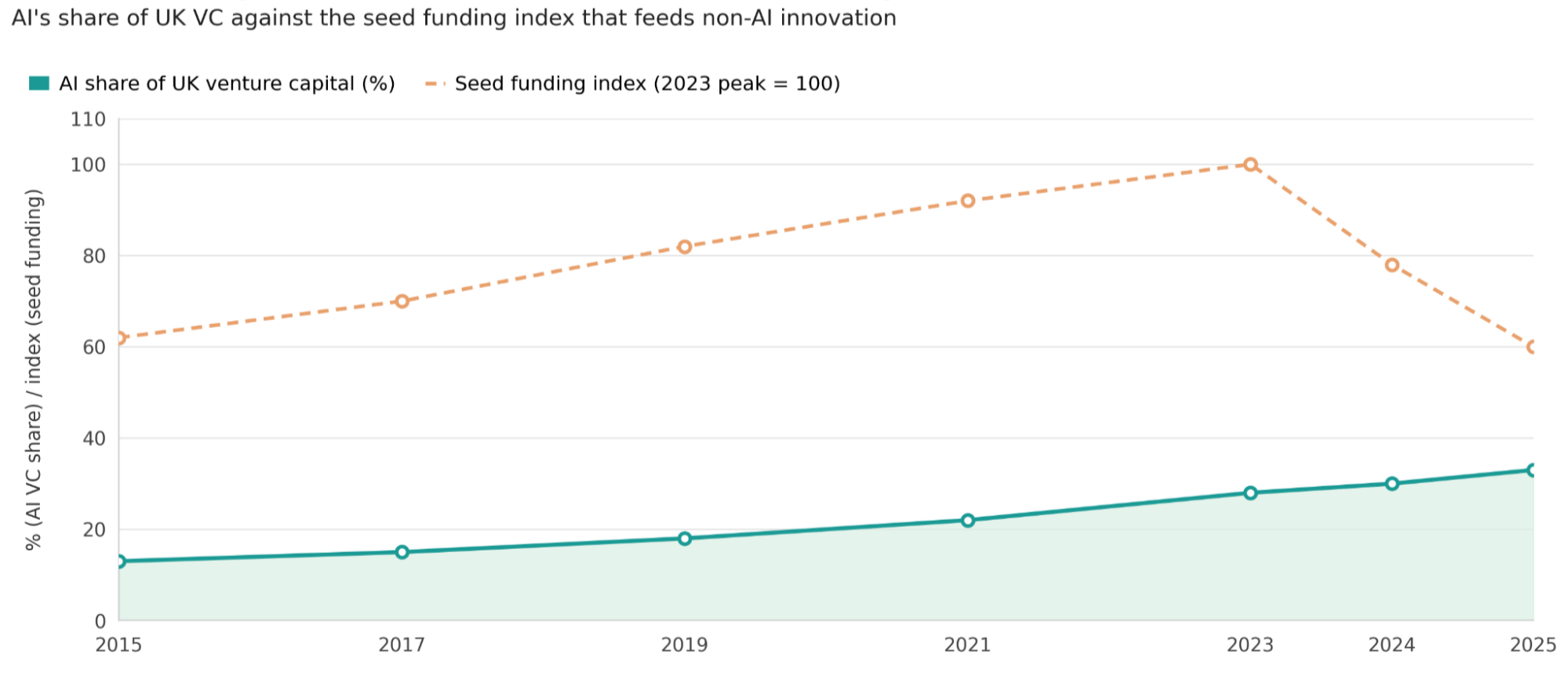
UK Venture Capital Allocation: AI Share vs Seed Funding, 2015-2025
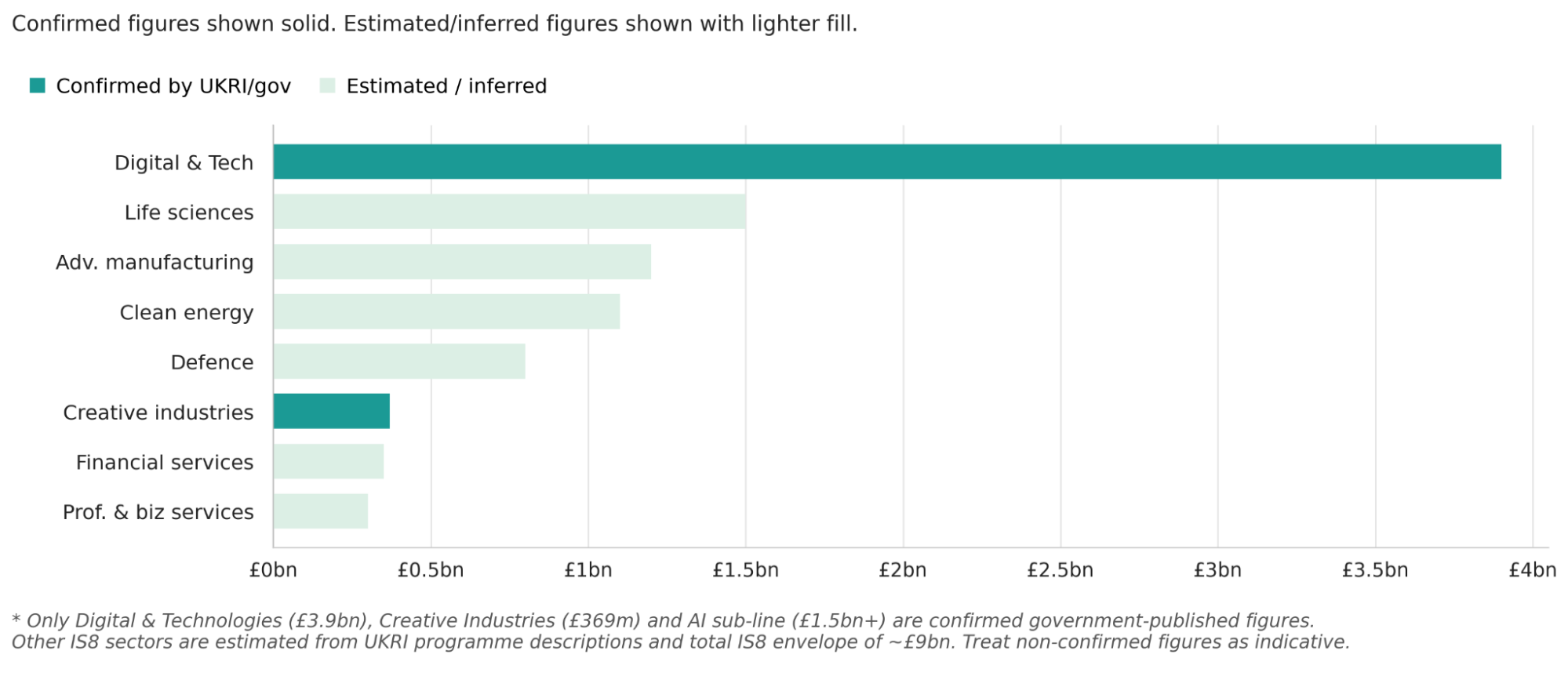
UKRI IS8 Allocation by Sector (4-Year Totals, £bn)
Insight #3: Sector concentration is not uncommon in industrial strategy history. But without public-interest protections and a domestic stake in the outcome, we are more exposed to system fragility than others.
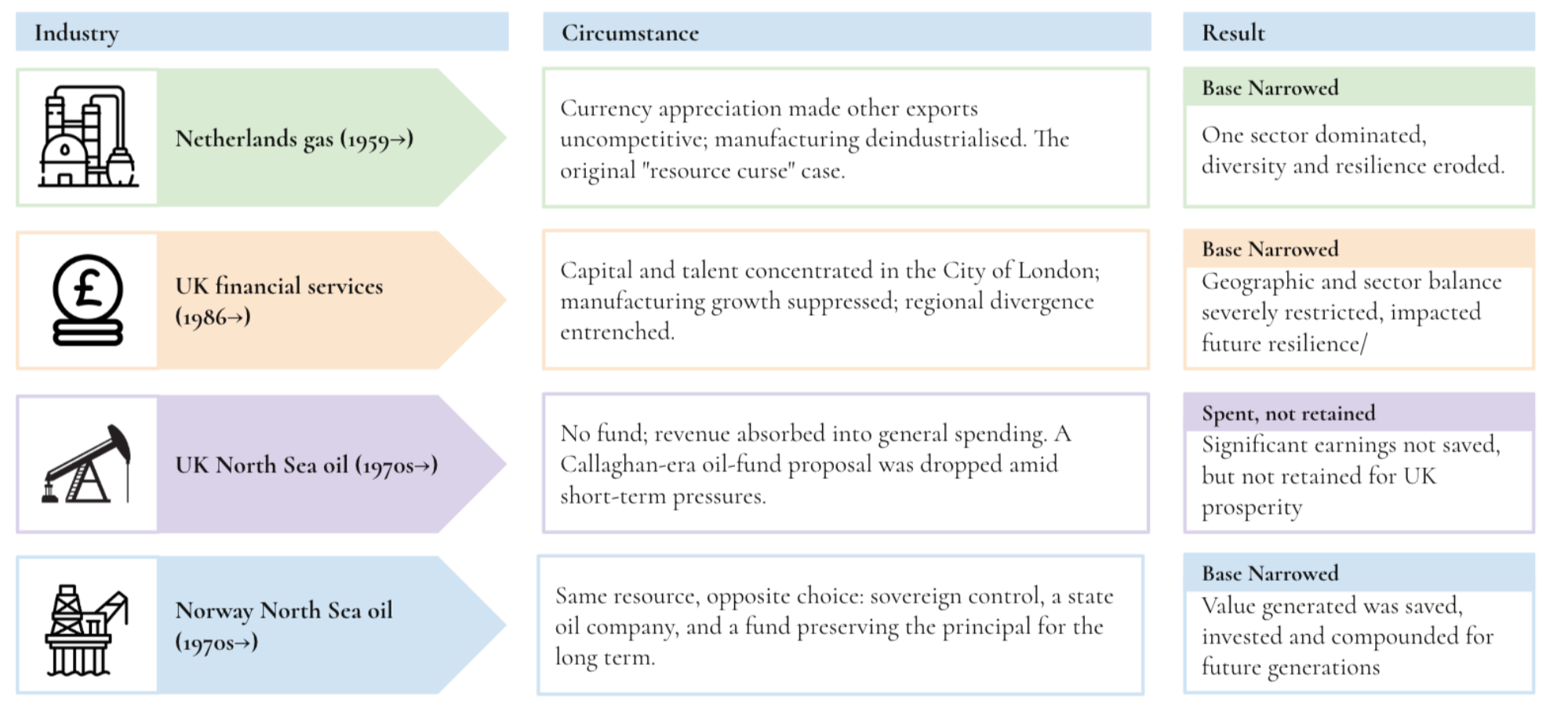
The UK has run this experiment before, on North Sea oil, so we know exactly how this unfolds if we don’t instill public interest and domestic protections: A proposal to save the oil revenue for public good was dropped under short-term political pressure, and the money was simply spent. Compare that to Norway, drilling into the same resource in the same decade, but they made the opposite choice by creating sovereign control: A state oil company, and a fund built to preserve the principal for generations. While we don’t back oil in any stretch of the imagination, or believe we can conjure a national wealth fund without the base resource - the focus isn’t the resource, it’s the industrial strategy foresight to protect the public’s interests in the long term. This is a very real problem, as we see the same story playing out with wealth concentrating AI.
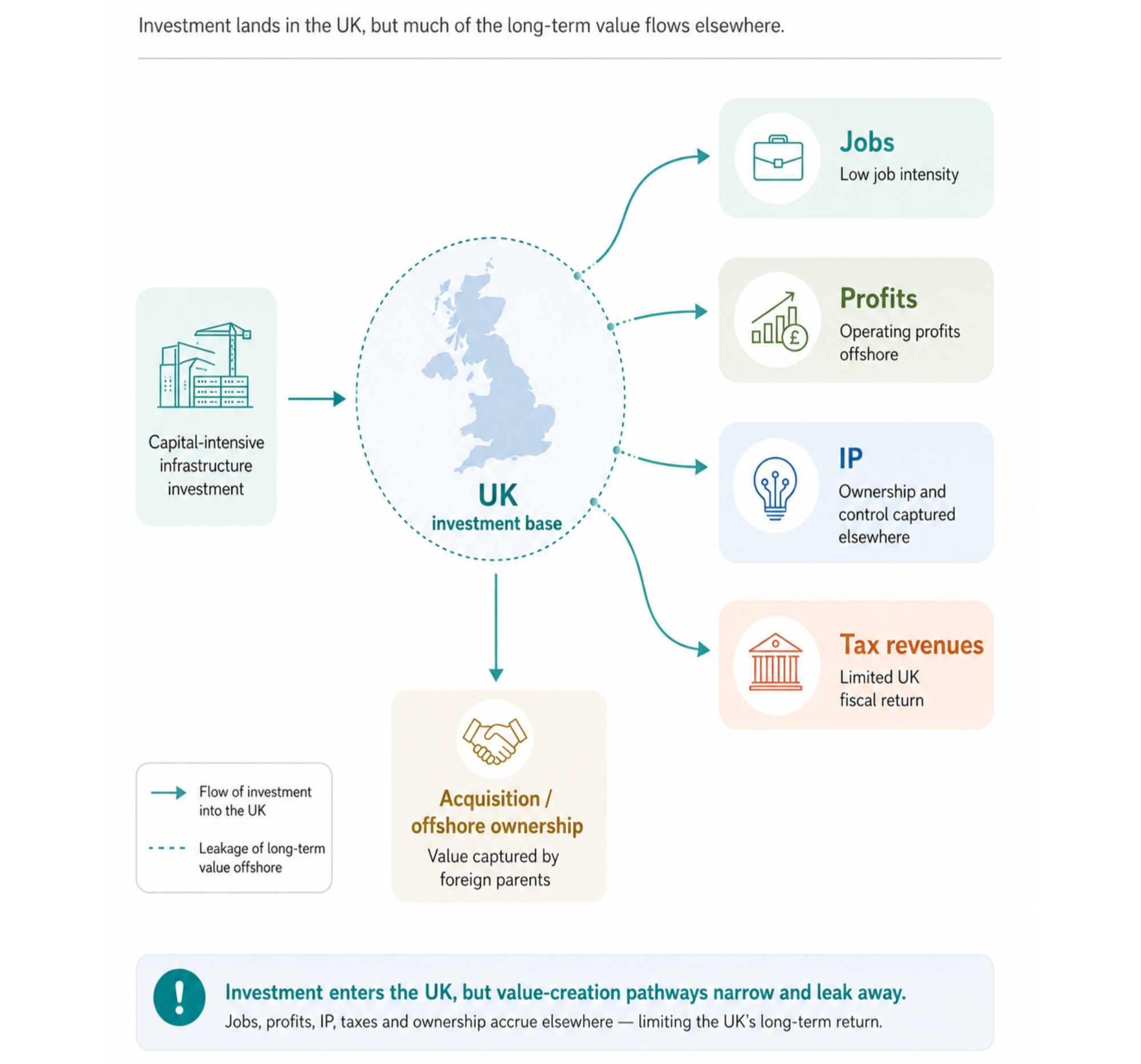
Insight #4: As the trajectory of sector concentration continues, the long-term value creation pathways will narrow further — job creation, intellectual property, profits and tax revenues among them.
If we look at the UK innovation landscape, a widely praised ca. £44bn of AI data-centre private sector investment is expected to flow into the UK over the next year. However, this will mostly be deployed from Microsoft, Google, Nvidia and AWS. So while the infrastructure will sit on UK soil, the jobs, profits and tax revenue mostly won't. Capital-intensive infrastructure like this creates, on average, just one job per £1.87m invested, and depreciates in 3–8 years against decades for our historic transformation success stories, e.g. railroads or fibre. At present, we subsidise this generously through some of the most favourable tax relief systems in the OECD. Admirable in intent, but unless we provide mechanisms to make it rationale for our best domestic talent, enterprise and investment to remain in-country, the lion’s share of our potential national value creation, can and is leaking offshore.
Value Creation Loss for the UK
Insight #5: The rate of change is accelerating, so our response time matters. The UK needs agility and optionality to build resilience — not just for this transformation, but the next ones, too.
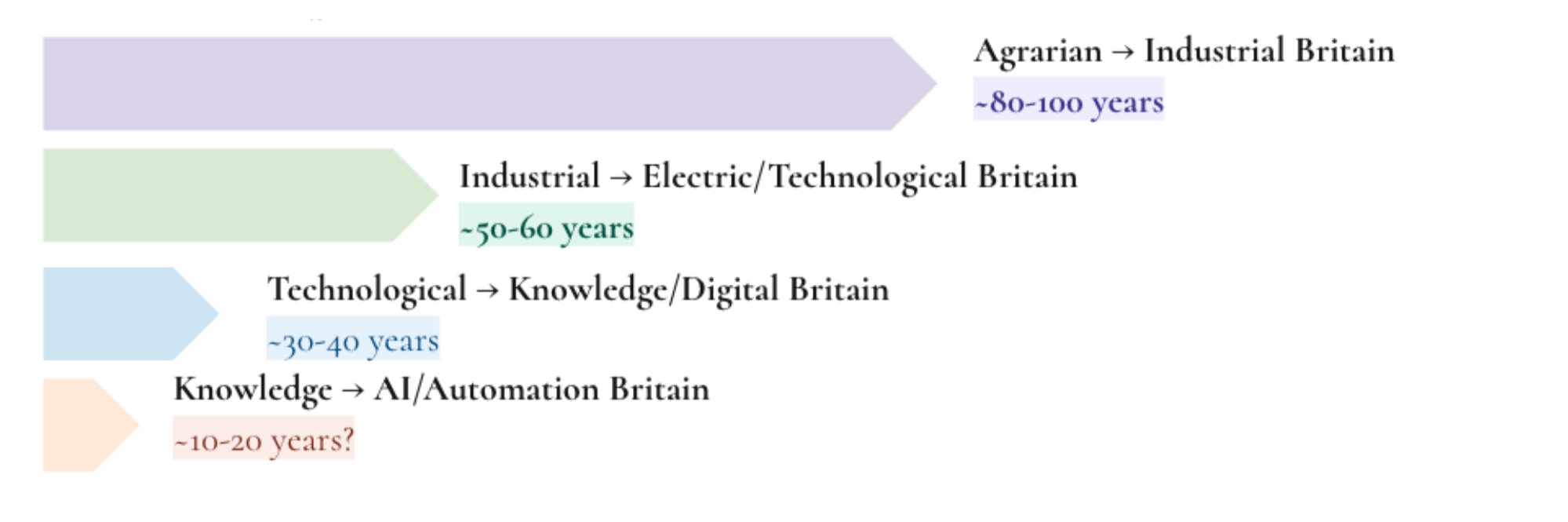
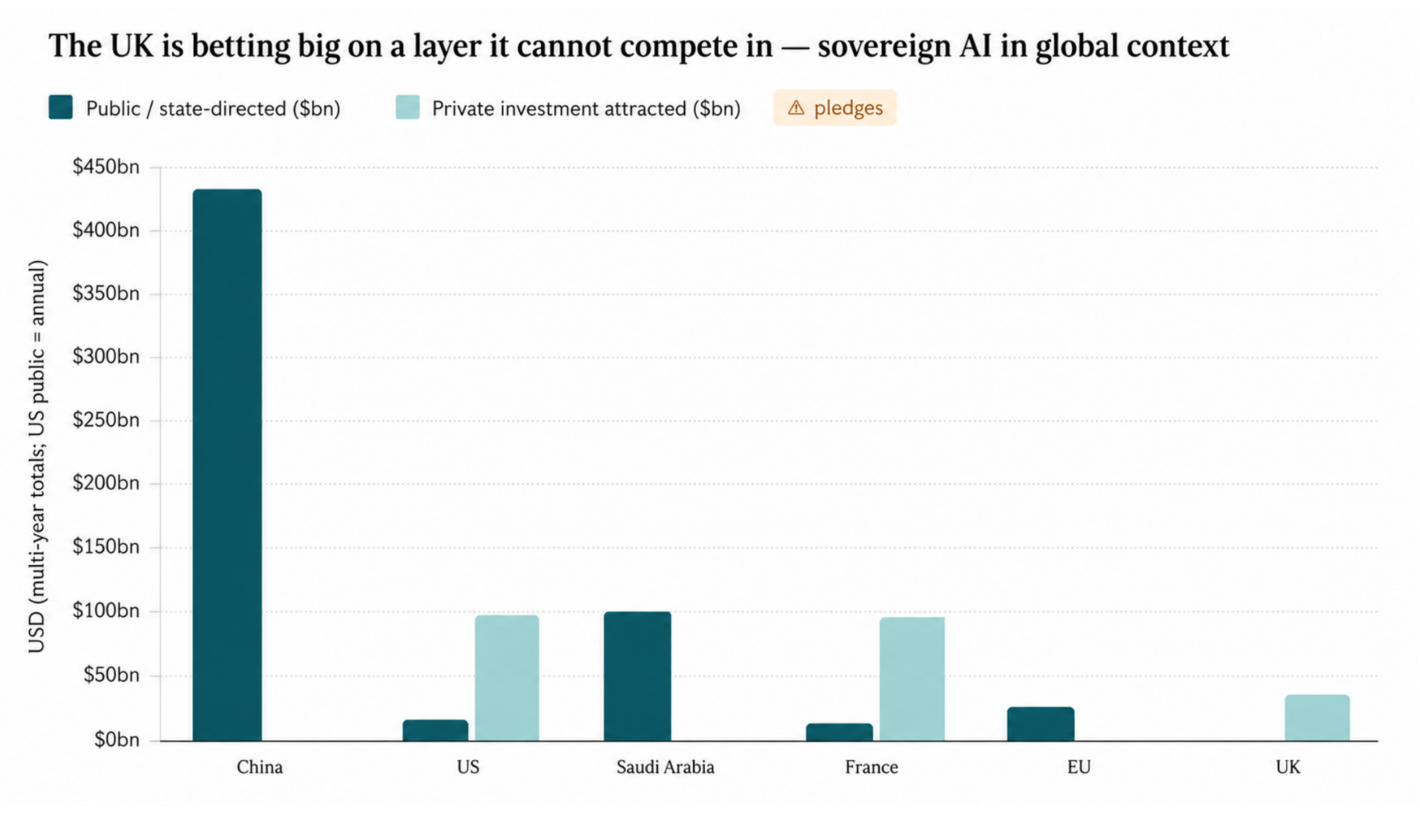
Looking back in history, every societal transformation in the UK has arrived faster and lasted less time than the one before it. The agrarian to industrial Britain took 80–100 years, while the industrial to electric transformation took 50–60. Then, more recently, the bulk of the transition from the knowledge economy to the digital economy took about 30–40 years. If historical precedents are anything to go by, AI and automation could be expected to cause meaningful societal transformation in as little as 10–20 years. Through each faster transformation, the margin of error for big but misplaced bets gets smaller, and the cost of concentrating on the wrong thing hits faster. Looking at the public investment figures across the world, the tension of the deep pockets of our sovereign AI bets sits starkly against the level of investments made by our peers. Our comparative public sector investments are so low, they don’t even visibly register on a bar chart.
Historical societal transformations and their duration
Comparative global investments into a UK prioritised sector: AI
Our recommendations:
From our research, we believe that our current national innovation strategies are creating significant future system fragility at a time we may need it most. To build a more resilient response, we need to focus on three things:
Building resilient innovation institutions that operate outside of political pressures and cycles.
Smartly diversifying the pipeline, through targeted actions on the highest value creating opportunities in adjacent sectors, regions and talent.
Creating mechanisms that can retain the UK's successes onshore.
The recommendations formed the basis of our follow-up multi-stakeholder workshops and stakeholder engagement, and together they have been turned into a series of specific actionable strategies that we hope will be of value to key stakeholders in the system. You can find these strategies in our full findings report. If you would like to receive a copy, please reach out to me directly on kate@103.ventures.
As always, thoughts and builds welcome.
The 103 team.
Footnote:
Over the last year, 103 has had the good fortune to investigate several sectors in depth to identify their transformation risks and opportunities. Spanning sustainable finance - from the bonds market to the macroeconomic landscape - to three converging ecosystems in the UK: energy, science and innovation, and workforce skills. This article shares the findings of our innovation analysis, but needless to say, like always these topics converge at interesting intersections. If you’re curious where, give us a shout on kate@103.ventures.
